9 July 2026
Open Subsidiary vs. Branch in Bulgaria
Foreign investors in Bulgaria choose between opening a branch or a subsidiary based on liability and other factors. Find out more here.

Foreign investors in Bulgaria can choose between setting up a branch or a subsidiary in order to expand their business in the country. These two options are different in terms of liability as far as the parent company is concerned but they also offer a series of advantages for company management and control in Bulgaria.
The table below summarizes the main traits of the branch and the subsidiary:
| Main Trait | Branch | Subsidiary |
| When to incorporate | The branch is an extension of the parent company and it can be incorporated when that foreign entity needs a Bulgarian counterpart to conduct the same business operations. | The subsidiary is a separate company and it can be used by a foreign corporation that wants to partially control interest in its Bulgarian counterpart. |
| Liability | In the case of the branch, the foreign company abroad is fully liable for the debts and obligations of its Bulgarian branch. | The subsidiary is liable for its own debts and obligations in Bulgaria, just like any regular resident company. |
| Level of independence | The branch has a low level of independence, it reports to the parent company and as far as accountant maintenance are concerned, in some cases, they can be handled jointly. | The subsidiary is an autonomous legal entity that may or may not report to the foreign company. It handles its accounts separately. |
| Taxation | The branch is subject to the 10% corporate income tax rate on its profits derived from the country. | The subsidiary is subject to the 10% corporate income tax rate on its worldwide income. |
The choice between a branch and a subsidiary depends on the business activities the foreign company wishes to engage in Bulgaria. Foreign investments are allowed in the country and full foreign ownership is allowed for all types of companies. The favorable business and tax regimes have attracted many foreign investors in the country. Entrepreneurs can rely on the help of a law firm in Bulgaria to commence the company registration procedures.
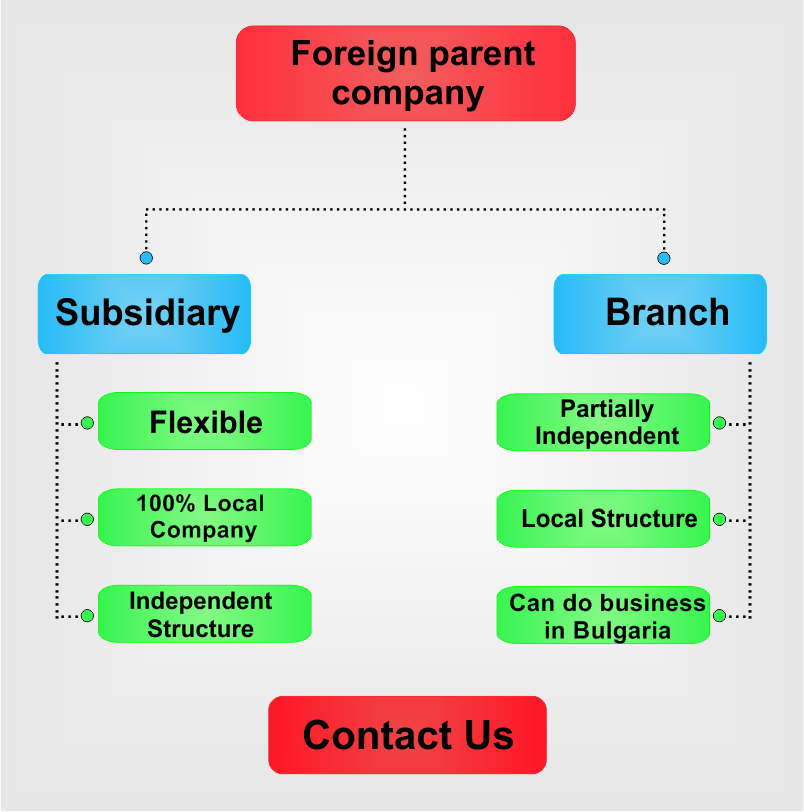
The branch in Bulgaria in 2026
At the level of 2026 the Bulgarian branch is an extension of the main foreign company and it fully depends on it for the debts and obligations in Bulgaria. While this business form does not have its own legal entity, it can enter into agreements, manage properties in Bulgaria and have a registered office. The branch also has to observe the annual reporting requirements and it is subject to taxation. The double tax treaties signed by Bulgaria with other countries can apply to the income derived by a branch in the country.
The branch needs to be registered with the Commercial Register. One of our lawyers in Bulgaria can help you during this step or can represent you through a power of attorney if the legal representative of the foreign company cannot be present in Bulgaria at the time of the registration.
The subsidiary in Bulgaria
The subsidiary is a separate business entity from the foreign company. It does not have to engage in exactly the same business activities and may have another or a slightly different name, according to the name availability on the Bulgarian market.
Under the legislation available for 2026, the subsidiary is a newly formed Bulgarian legal entity. Most often investors choose to open a limited liability company because of the clear distinction between the assets of the company and the personal assets belonging to the shareholders. This company will fully comply with the taxation principles in the country and also with the accounting and reporting requirements.
Company registration is mandatory for all new companies in Bulgaria. According to the chosen business field, these companies will also need to obtain special permits and licenses. The experts at our law firm in Bulgaria can give you additional information about these licenses.
These business forms may be subject to other regulations, such as VAT/VIES registration when they provide intra-community services, or EORI registration when they import or export goods to or from non-EU countries.
How to choose between a branch office and a subsidiary in Bulgaria in 2026
The expansion of operations in Bulgaria in 2026 can be done through a branch office or a subsidiary depending on the control the parent company wants to have over the establishment of the Bulgarian-based enterprise. While the first will ensure a full control of the foreign entity, the second one will enable the company to operate as a domestic vehicle.
From a taxation point of view, the Bulgarian subsidiary and branch office will pay the corporate tax at the same rate applicable for 2026, however, the income taken into account is different. The subsidiary will pay it on its entire income, while the branch only on the profits earned in Bulgaria.
If you need more information on the procedure of opening a branch or a subsidiary in Bulgaria in 2026, do not hesitate to send us your questions via email and you will receive an answer as soon as possible.
Bulgaria adopts euro as its national currency
Starting a subsidiary has become easier for foreign companies, as on January 1st, 2026, Bulgaria (an EU member since 2007) joined the euro area by adopting the euro as an official currency. The euro replaced the Bulgarian lev (BGN) at a conversion rate of 1.95583 BGN = 1 EUR. Since July 2020, the lev participated in ERM II at this central rate until the changeover (it had been pegged under a currency board since 1997).
With effect from January 1st, 2026, Regulation (EC) No 2866/98 was amended to add the irrevocably fixed BGN conversion rate. Since then, monetary policy for Bulgaria has been set by the European Central Bank, with the Bulgarian National Bank as part of the Eurosystem.
Dual price display (BGN and EUR) was mandatory from 8 August 2025 to 8 August 2026 and prices are now shown in euro only; to complete the transition to euros, businesses must keep their accounting, invoicing, and pricing systems in euro (existing companies must also convert their registered capital to euro by the end of 2026).
If you would like to explore other business options, like opening a representative office before considering opening a branch or using a virtual office to operate a Bulgarian company, please feel free to contact our attorneys in Bulgaria.