6 August 2024
Immigrate to Bulgaria
If you want to immigrate to Bulgaria, contact our lawyers. Our Bulgarian law firm is at your service if you are interested in migration to Sofia.

In recent years, Bulgaria has become an important destination for citizens in neighboring countries interested in relocation. However, these are not the only persons deciding on immigration to Bulgaria, but also non-EU citizens who want to obtain access to EU residency.
People who want to migrate to Bulgaria will enjoy a flexible taxation system with very competitive rates compared to other European countries, as well as great employment and business possibilities. In other words, the small Southeastern European country has become a great destination for most foreign citizens interested in exploring new opportunities. Below, our Bulgarian lawyers explain the main steps to complete when moving here. We can help you during the entire procedure.
| Quick Facts | |
|---|---|
| Entry visa requirement (from EU) (YES/NO) | No |
Entry visa requirement (outside EU) (YES/NO) | Depends on nationality: many non-EU nationals (e.g. US, UK, Canada) can stay visa-free for up to 90 days in any 180 days; a national D visa is needed for long stays |
Types of visas available | – temporary residence permit, – work visa, – EU Blue Card |
| Time frame for obtaining work visa (approx.) | Approx. 3 weeks |
| Validity of temporary residence permit | 6 or 12 months |
| Temporary residence permit renewal requirements | It can be renewed for up to 5 years |
| Documents for obtaining a residence permit | – valid passport, – proof of local address, – proof of financial means to support oneself, – health insurance, – other supporting documents based on the reason of relocation |
| Time frame for obtaining permanent residence (approx.) | 5 years of living in the country |
| Investor Visa availability (YES/NO) | Yes, permanent residence for investments of at least EUR 511,292 (formerly BGN 1 million) in approved funds or listed shares |
| Start-up Visa Scheme availability (YES/NO) | Yes |
| Sponsorship requirement (YES/NO) | No |
| Time frame for obtaining citizenship | 5 years of permanent residence |
| Citizenship/Residency by investment scheme availability (YES/NO) | Residency only: permanent residence from EUR 511,292 in approved funds or listed shares; citizenship by investment (incl. the fast track) was abolished in 2022 |
| Taxation of foreign citizens | 10% income tax rate applicable to income obtained in Bulgaria |
| Tax benefits for expats | Access to approx. 60 double tax treaties |
The main types of visas available for immigration to Bulgaria
Bulgaria is quite flexible when it comes to immigration regulations and types of visas available for foreigners. Bulgarian visas can be obtained for a variety of reasons, including visiting family or friends, setting up a company, traveling for tourism, etc.
The national D-visa is one of the most popular options when immigrating to Bulgaria and it is issued to individuals interested in acquiring real estate or who register corporate forms on behalf of foreign firms in Bulgaria or domestic companies.
The requirements for people moving to Bulgaria to work, establish a business, marry a Bulgarian citizen, or as a company representative, pensioner, or family member fall under several types of D-visas.
Foreign nationals may visit Bulgaria for up to 90 days for one of the following 3 reasons based on a C visa:
- business;
- personal motives;
- tourism.
Bulgarian consulates usually decide on such visas within 15 calendar days. Both a business invitation and a personal invitation letter are necessary for the first two categories. If you need information about these types of visas, feel free to address our immigration lawyers in Bulgaria.
The most popular Bulgarian residence permits and their validity
Three different forms of residence visas are outlined in the Foreigners in the Republic of Bulgaria Act. These are also the most sought by those interested in long-term immigration to Bulgaria:
- The long-term resident permit:
All non-EU foreign nationals must have a long-term D visa before submitting an application for an extended residence permit. The validity of this kind of permission, also known as a prolonged residency permit, is up to one year.
- The EU long-term residence permit:
This status is granted to non-EU nationals after 5 years of legal and continuous residence in Bulgaria (not to EU citizens, who only register). It gives certain rights to move to other EU states; holders need a valid passport or ID card. The validity of this type of permit can be extended to 5 years.
- The permanent residence permit:
Prior to being granted a permanent residence visa, immigrants must first secure an extended residence permit and maintain it for at least 5 years. One of the primary prerequisites for acquiring a Bulgarian passport and citizenship is the issuance of this kind of permit, which is granted for an indeterminate period of time.
If you need support in applying for any of the permits presented above, you can rely on our law firm in Bulgaria.
Bulgarian immigration procedures
When it comes to choosing to move to Bulgaria, there are two procedures to consider:
- the one applicable to EU citizens;
- the ones available for non-EU citizens.
We mentioned the ones applicable to non-EU citizens, as these have several legal pathways through which they can immigrate to Bulgaria.
If you decide to migrate to Sofia, our immigration lawyers in Bulgaria who have an office in the capital are at your disposal with quick legal services.
How to immigrate to Bulgaria as an EU citizen
If you are an EU citizen, you will have nothing to worry about if you want to relocate to Bulgaria. As a matter of fact, once you enter the country, you need to obtain a residence certificate if you intend to settle here. However, if you plan on staying in the country for less than 3 months (during which you can decide if the lifestyle suits you and you can get used to living here), there is no need to apply for any visa.
You can decide for migration to Sofia, which has one of the largest communities of expats in the country, and our immigration lawyers in Bulgaria can help you settle here right away.
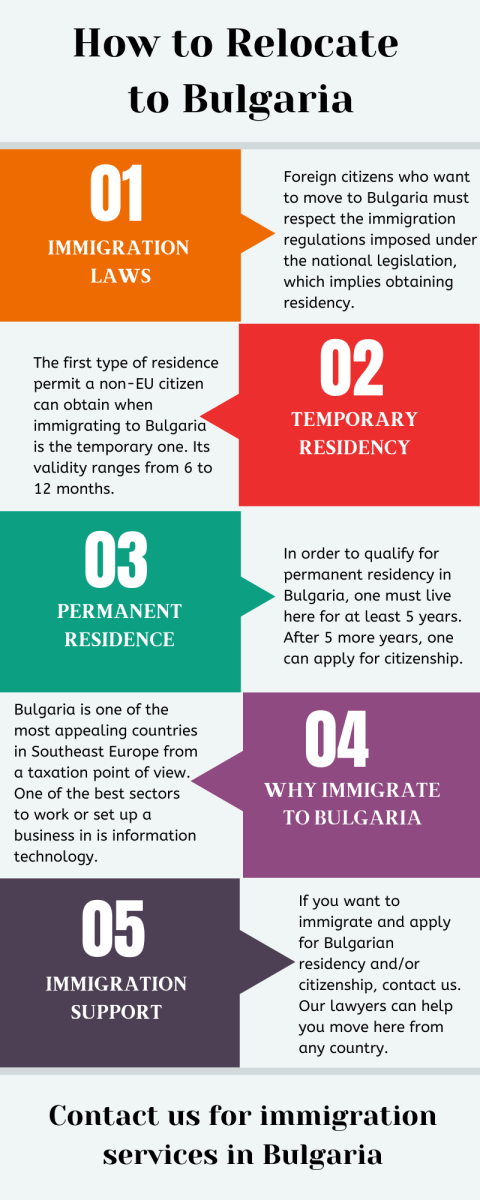
Find out more on this subject in the infographic below:
How to migrate to Bulgaria as a non-EU citizen
If you are a non-EU citizen and want to move to Bulgaria, you can apply directly from your home country for one of the following types of residence permits:
- a temporary residence visa;
- a work visa;
- an investor visa;
- the EU Blue Card is also available for non-EU citizens.
Student visas are also available for non-EU citizens who want to immigrate to Bulgaria, however, these are issued for the duration of the studies.
By far, the investor visa which can lead to Bulgarian citizenship is often the choice of most non-EU citizens, as it was created for those willing to invest and have the financial power to contribute in a significant way to the country’s economy.
Non-EU citizens who are already established in other EU member states can visit Bulgaria for up to 90 days in any 180 days on those residence cards, but need a Bulgarian permit to settle here (except under EU mobility rules, e.g. for Blue Card holders).
If you need time or information to help you decide on how to migrate here, our law firm in Bulgaria can be your guide, so do not hesitate to ask for support.
Immigration to Bulgaria based on an EU Blue Card
If you want to immigrate to Bulgaria as a non-EU citizen, the Blue Card can be a good option if you meet the following requirements:
- you obtain a job with a Bulgarian company with a work contract of at least 6 months;
- the job offer is based on a gross salary of at least 1.5 times the national average gross salary (approx. EUR 2,050 per month in 2026), or approx. EUR 24,600 per year.
The position you occupy must be that of a highly skilled employee.
All applications for residence permits are handled by the Migration Directorate which is supervised by the Ministry of Interior in Bulgaria.
Our Bulgarian law firm can help you apply for any type of residence permit. You can also watch our video on this subject:

Obtaining permanent residency in Bulgaria
An application for permanent residence may be submitted after 5 years of ongoing residence in Bulgaria. The candidate will be granted the same rights as a Bulgarian citizen as a result, with the exception of the right to vote.
Foreign nationals may also apply for permanent residency if they have been married for 5 years to a Bulgarian citizen or a foreigner with permanent residence in Bulgaria. The 60 days before the expiration of the long-term residence permit are the deadline for submitting applications for a permanent residence permit. After the documentation is submitted, the permit is issued in approximately 2 months.
Citizenship – completion of the Bulgarian immigration procedures
Depending on your situation, there are several options to apply for Bulgarian citizenship:
- citizenship by birth in Bulgaria which is inherited through parent or parents;
- naturalization which implies an applicant to satisfy the standards outlined by the Bulgarian government;
- marriage is also a way through which citizenship in Bulgaria can be obtained.
Why decide on migration to Sofia
Sofia is one of the most beautiful and full of opportunities cities in Bulgaria. Here, you will find not only great business opportunities, but also employment ones.
The Bulgarian government encourages entrepreneurship mainly through low taxes and industry incentives, information technology being one of the most important in this sense. Sofia is one of the country’s largest IT hubs.
If you are interested in migration to Sofia, our local law office is at your service.
Sofia is also the most populous city in the country, with more than 1.1 million citizens at the level of 2019. Other important cities are:
- Plovdiv which accounted for 340,494 inhabitants in the same year;
- Varna, which is one of the most important touristic centers with a population of 312,770 citizens;
- Burgas with 195,966 inhabitants and Ruse with 156,238 citizens.
Also, according to statistics:
- in 2021, the number of foreign-born citizens in Bulgaria was 0.2 million people;
- at that time, immigrants represented 3% of Bulgaria’s population;
If you want to immigrate to Bulgaria and need assistance, do not hesitate to get in contact with our lawyers who can help you apply for any type of residence permit.